AM ERSTEN TAG UNSERER EHE WERF MIR MEIN MANN EIN FETTIGES GESCHIRRLAUCH INS GESICHT UND SAGTE: “VON JETZT AN BIST DU DIE MAFLIEGE MEINER FAMILIE.”
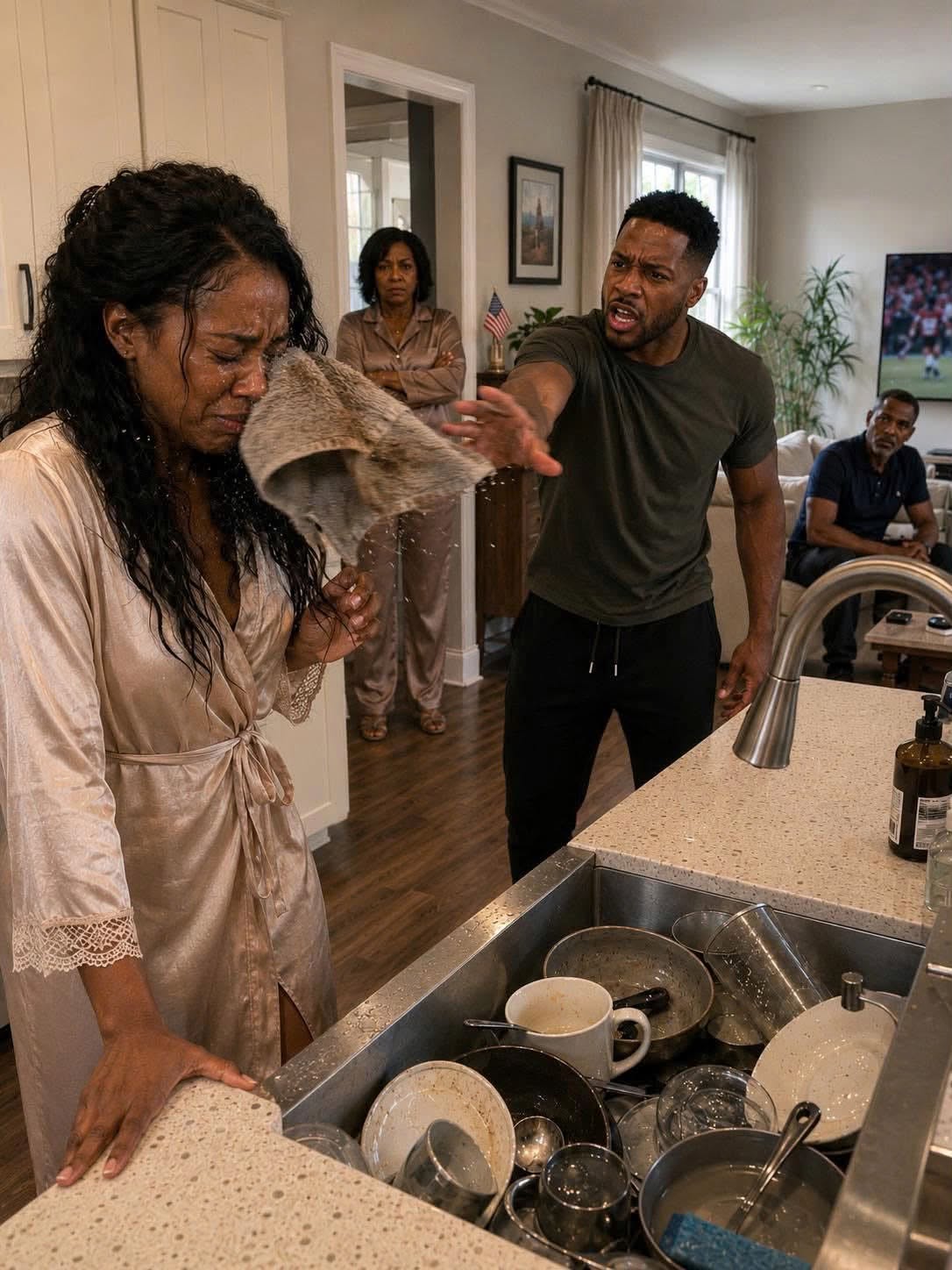
ON THE FIRST DAY OF OUR MARRIAGE, MY HUSBAND THREW A GREASY DISHCLOTH IN MY FACE AND SAID, “FROM NOW ON, YOU’RE MY FAMILY’S MAID.” I SMILED, LEFT MY WEDDING RING ON THE TABLE, AND WALKED OUT WITH MY SUITCASE.
“From today you are not a guest in this house and you are not a princess. You cook, you clean, you look after my family. That is what I married you for.”
And the wet cloth he threw caught my cheek and stuck in my hair, and it smelled of fat and dried chilli and old food.
It was the morning after the wedding.



And Rosalba was in the kitchen doorway with her arms folded, and Nico did not look away from the football.
“Did you hear me, Renata? You are not going to live off this family.”
And I pulled that rag out of my hair, slowly, and what was in me was humiliation and something else that arrived with it, which was clarity.
The night before, in front of more than two hundred people at the Miravalle, Emiliano had promised to respect me and to make me the happiest woman alive.
And my parents had cried listening to it.
And to start us off, his family had given us four hundred and fifty thousand dollars as a wedding gift. My parents did not keep a peso of it. They put it into an account in my name and added two hundred thousand of their own.
“So that you never have to depend on anybody,” my father said.
And until that morning I thought he was fussing.
And I looked at that sink — the dishes, the burnt pans, the mugs with rings in them.
And I smiled.
“Understood,” I said. “Cook, clean, serve, and earn the right to eat.”
And he looked disappointed. He had been expecting tears or an argument or an apology.
“Then start,” Rosalba said. “And when you have finished, separate his washing. The dress shirts are done by hand.”
And I went into that kitchen and turned the tap on and washed my face three times.
And I put the rag on the counter and went upstairs and shut the bedroom door quietly.
And my case was still nearly packed.
And I took my documents and my clothes and the laptop and the chargers and the card for the account with the wedding money in it. And the envelopes from my relatives.
And I took the ring off and put it next to the wedding photograph.
And downstairs he shouted: “Renata! If you are not finished in thirty minutes you do not eat today!”
And a few minutes later I came down the stairs with my case.
And Rosalba’s face.
“What is this supposed to be?”
“You are right. I should not live in your house for nothing. So I am going.”
And he was on his feet. “Stop being dramatic. Go up, unpack, and apologise.”
“No.”
And he reached for my arm and I stepped back.
“If you go out of that door, do not come back.”
“I sincerely hope not.”
And I opened it, and looked back at that kitchen.
“By the way — the dishes are still dirty. So is the rag. Divide it between yourselves.”
And I shut the door and blocked his number.
And at the bus stop I rang my mother.
“Mamá. I am getting a divorce.”
And there was a pause.
“Come home, mija. It is not the end of the world.”
What they found that night.
Not an empty account. That is what everybody assumes and it is not what happened.
What Rosalba and Nico Cuevas found that night, when they finally sat down with the papers, is that the four hundred and fifty thousand dollars they had given us was not theirs.
It was borrowed.
From Don Ismael Barraza, who is sixty-eight and who has known that family since about 1990, in the August of 2025, against the shop on Calle Ocotlán.
Ferretería Cuevas. Four employees. Nico’s father opened it in 1971.
And they borrowed it to give it to us in front of two hundred people at the Miravalle, because that is what the Cuevas do, and because Rosalba had been telling that city for a year what her son’s wedding was going to be.
And my parents, who are not that, took it and put it in an account in my name and added their own two hundred thousand on top.
So at about ten o’clock on the night of the fifth of October, 2025, that family worked out that they owed six hundred and something thousand dollars with interest to a man of sixty-eight, secured on a shop, and that the money was in the name of a woman who had walked out of their house that morning with a suitcase.
When I knew.
The nineteenth of September.
Fifteen days before the wedding.
My father found out — Valdoria is a small city and he has been in business in it since 1988 — and he came to my flat on a Friday evening and sat down and told me.
And he did not tell me what to do. He has never once in my life told me what to do and I have resented it for about ten years.
He said: “I am telling you so that you know what kind of people they are.”
And I said that I would think about it.
And I married Emiliano Cuevas fifteen days later.
Why I went ahead.
The invitations had gone out in the July.
Two hundred and eleven people. A hall that was paid for. My mother’s dress, which she had had done.
And I was twenty-seven and I had been with that man for three years and I had told everybody in Valdoria that I was marrying him.
That is the whole of it and it is not a good reason and I have had fourteen months with it.
And underneath that there is something else, which took until about the May to say out loud.
By the nineteenth of September I already knew what I was marrying. Not the dishcloth — I did not see that coming and nobody could have.
But I knew by about the June. There had been things. There was a thing with a waiter in the February that I have never told my mother about.
And when my father sat in my flat and told me that the gift was borrowed, what I felt was not shock.
It was that now I had something.
What I did on the twentieth of September.
I rang my father and asked him a question about the account.
Specifically: whether, once the gift was deposited in my name, there was any mechanism by which his family could get it back.
And he said no, not without my agreement.
And I said all right, and we talked about something else.
That is the call. The twentieth of September, 2025, fourteen days before I stood in the Miravalle in a white dress.
And I have told this story about thirty times and in every version the account in my name is my father’s foresight, and my own first thought about that money is on the stairs on the fifth of October with a rag in my hair.
My first thought about that money was on a telephone on the twentieth of September.
The two hundred thousand.
My parents’ savings.
And my father said it so that I would never depend on anybody, and I have been quoting it for fourteen months, and it is in the first part of this.
What I have not said is what my mother said.
In the August, in her kitchen, about three weeks before my father found anything out.
She said: “Renata. Does he ever ask you what you think?”
And I said of course he does.
And she said: “When?”
And I could not produce one.
And instead of sitting with that I told my own mother that she was being old-fashioned and that not every marriage has to look like hers.
She did not mention it again. Not in the September, not in the week of the wedding, not on the morning of it when she was doing my hair.
And then they put their savings in anyway, because she had already worked out what I was walking into, in a kitchen, in August, in nine words.
The fourteen days, which I have been calling going ahead and which I have now had to look at properly.
The nineteenth of September to the fourth of October.
And I did four things in them that I have never told anybody.
On the twenty-second I rang the bank and confirmed that the account was in my sole name and asked what would be needed to change that, and was told that only I could.
On the twenty-fourth I had the final fitting and my mother cried and I let her.
On the twenty-eighth I went to that house for a Sunday meal and sat at a table with Rosalba Cuevas, who had borrowed four hundred and fifty thousand dollars six weeks earlier, and I complimented her on the chicken.
And on the first of October I spoke to Emiliano on the telephone for about forty minutes about the seating.
Four normal things, done by a woman who already had everything.
And I have described those two weeks, when anybody asks, as a blur.
They were not a blur. I was extremely clear. I remember what I said to the woman at the bank and I remember the chicken.
And at no point in fourteen days did I sit down with my mother, who had asked me nine words in the August, and tell her what my father had found.
Paulina.
Emiliano’s sister. Twenty-two.
She worked in that shop. She had worked in it since she was seventeen and she was going to have it.
That was the arrangement and everybody in that family knew it and Nico had said it to her face in 2023.
And the loan was secured on it.
It went in the April of this year. Not to Don Ismael — he did not want a hardware shop and he behaved better than anybody in this, which I will come back to.
It was sold to clear what could be cleared, and it went for less than it should have because everybody in Valdoria knew why it was on the market.
Four people lost their jobs. One of them is a man of sixty-one who had been there since 1994.
And Paulina Cuevas is twenty-three now and she works at a place out by the airport.
And she never said one word to me. Not on the day, not since.
And the funeral in the December, which was for a neighbour of my parents and which I have made into a scene with one line in it.
She did not simply come over.
She waited. I have thought about this since.
I was there about ninety minutes and she was there for all of it and she came to me at the end, outside, when people were going to their cars — which is the only part of a thing like that where you can say something and then leave.
She had chosen the moment the way you choose a moment when you have decided something in advance.
And after she said what she said, she stood there for about four seconds.
And I did not fill them.
I have gone over those four seconds more than almost anything in this, because I know what should have gone into them, and it is not complicated and it is not even about money.
It is: Paulina, I knew in September.
Seven words, outside a church, in December, to a woman of twenty-two who had just told me she was glad I got out.
And instead I said something kind about her mother, and she nodded, and she went to her car.
And four months later the shop was sold.
What she did say.
Once. In the December, at a funeral, which is where people in that city see each other.
And she came over and I braced for it.
And she said: “I am glad you got out.”
And I said something.
And she said: “I asked him in the August where the money came from. He told me not to be stupid.”
She had asked. At twenty-two, in a shop that was about to be put against a loan, she had asked her own brother.
And her brother told her not to be stupid, and she dropped it, because she was twenty-two and he is thirty.
And I had the answer. From the nineteenth of September I had the whole answer, and I was in that family’s house on the fourth and fifth of October, and I never said one word to her.
And the two hundred and eleven people at the Miravalle, who I have mentioned twice as a reason.
And I went back to the list in the June, which is still in a folder at my parents’ house.
My great-aunt Elvira, who is eighty-three and who came from Tulancillo and who had not been out of her town since 2019.
Eleven people from my father’s business, who closed for a day.
Three friends from school with young children, who arranged things.
And my cousin Marisol, who was due in the November and who should not have been in a hall until midnight and who came anyway.
And I have been saying for fourteen months that I went through with it because of two hundred and eleven invitations, as though they were a weight on me.
Not one of those two hundred and eleven people would have been angry with me for cancelling a wedding to a man who turned out to be what he turned out to be.
Every single one of them would have been on my side inside four seconds.
It was never them. It was that cancelling meant standing in front of them and saying that I had been wrong about him, out loud, at twenty-seven, in Valdoria.
And it was easier to marry him and be wronged than to call it off and be mistaken.
Don Ismael.
He is sixty-eight and he lent four hundred and fifty thousand dollars against a shop, which is a business decision and not a crime, and he has not behaved badly once.
He wrote to my father in the November and offered — through him, properly, not through me — to take a lower figure if the family would settle quickly, which would have left Paulina with the shop.
And Nico Cuevas turned it down, because taking it would have meant admitting in Valdoria what the wedding had been.
So the shop went in the April for the sake of a story.
And my father told me about the November offer in the May, and he told me because I asked.
And then he said one thing more, which is the reason I have written all of this down.
He said: “I told Ismael you had the money.”
What that means.
In the November of 2025, Don Ismael Barraza asked my father whether there was any prospect of the four hundred and fifty thousand coming back from me.
Because it is a reasonable question. It was his money, it went into an account in my name, and I had been married to their son for about eighteen hours.
And there is no legal route. I have been told that by two people and it is correct.
And there is another kind of route, which is somebody in that city saying to a man of sixty-eight: she will discuss it.
And my father said: “She has it.”
That is what he said. Not she will not give it back and not she is entitled to it. He told a man that his money existed and was intact, and he left the rest of the sentence out, because he is my father and because he was waiting for me.
And Don Ismael Barraza never contacted me. Not once in fourteen months.
And I never contacted him either.
And I knew, from the May, that my father had left that sentence open on purpose, and I have let it stand for eighteen months, and the shop went in the April.
And the April, which I have put down as the month the shop went and which I was aware of at the time.
The auction was on the fourteenth.
And I knew the date, because my father told me on about the second, not to prompt me and not to ask me anything — he told me the way he tells me things, as information, because that is what he does.
Twelve days.
And in those twelve days I did not ring Don Ismael Barraza and I did not ring my father back and I did not ring Paulina Cuevas, whose number I have had since 2023.
What I did on the fourteenth of April is work.
I know that because I remember the day and because I remember thinking, at about one o’clock in the afternoon, that it would be over by now.
At about one o’clock. I did the arithmetic on when an auction finishes, at my desk, and then I carried on with what I was doing.
And in the evening I did not look it up, and I did not look it up the next day either, and I found out it had gone through from my mother on the Thursday.
Twelve days of notice and a telephone in my hand.
And the version I give — when it comes up at all, which it does not — is that by then it was too late and the thing had its own momentum.
On the second of April it had no momentum at all. It had a date.
The four hundred and fifty thousand.
It is in that account.
All of it, apart from about nine thousand I spent on the solicitor and on a flat at Valdoria.
And I have never spent a peso of it on anything else and I have told four people that this is because it does not feel like mine.
That is true and it is also doing a job.
Because a woman who will not spend it is a woman who has not decided anything. And every month I do not decide, it is still open, and I am still somebody who might.
It is not mine in law either — it is mine completely, the lawyers are clear — and it was borrowed by a vain family from a careful old man against a girl of twenty-two’s shop.
And I could have ended that in the November with one telephone call, before the April, before four people lost their jobs.
And what I did instead was decide that it was complicated.
And my father, who I have let stand as the wise one in all thirty tellings.
He found it out in the September and he told me and he did not tell me what to do, and I have made that into a virtue about four hundred times.
And in the June I finally asked him why.
Why he had not said: Renata, do not marry this man.
And he looked at the table for a while, which he does, and then he said: “Because you would have.”
He meant that if he had told me to stop, I would have gone ahead, out of exactly the thing I have been in since I was about nineteen.
And he is right, and that is a terrible thing for a man of fifty-nine to know about his own daughter, and worse to have to act on.
So what he did instead was put a fact in front of me and leave the room, and then put two hundred thousand dollars of his own savings behind it, because he had calculated that I was going to walk into it and he wanted a floor underneath me when I did.
That is not wisdom. That is a man who had given up on persuading me and was building for the crash.
He has never once said so and he never will.
And when it came — the rag, the suitcase, the bus stop — he had it ready, and everybody in Valdoria says what a lucky girl I am.
Emiliano.
He threw a rag in my face and told me what I was for.
And nothing in this makes that smaller, and I would walk out of that house again in the same twenty minutes.
He is thirty-one now and he is at his mother’s and there is no shop.
And I have not spoken to him since the fifth of October, 2025, except through solicitors.
And I do not want to and there is nothing to say.
And the thirty tellings, which I counted in the September, because by then I had started counting things.
And there is a shape to it and I did not design it, and it arrived by about the fourth time.
It opens with the rag. Always the rag, and the smell of it, because the smell is what makes people put their hand over their mouth.
Then the dishes and the dress shirts done by hand.
Then cook, clean, serve, and earn the right to eat, which I said on the day and which is the best sentence I have ever produced under pressure, and which I deliver now with a small pause in front of it.
Then the ring next to the photograph.
Then the line at the door about dividing the work between themselves, which gets the laugh.
And then the money, and their faces, and the end.
Four minutes, and it has not failed once in thirty attempts.
And there is no Paulina in it. There is no shop on Calle Ocotlán and there is no man of sixty-one who had worked there since 1994, and there is no November and no Don Ismael.
There is not even my mother in it, except doing my hair.
It is a very good four minutes and I have been living inside it since the October, and everything that has actually happened since has had to go on outside it.
And the last thing.
My mother’s nine words.
***Renata. Does he ever ask you what you think?***
I have thought about them for fourteen months and I have only recently understood why they are the ones that will not go.
It is not that she was right about him.
It is that she asked me a question, in a kitchen, about my own life — and I could not answer it, and so I told her she was old-fashioned.
My father told me a fact in the September and let me decide.
My mother asked me a question in the August and let me decide.
Neither of them told me what to do, once, in twenty-seven years, and I have always said that this is the best thing about them.
And I have come to understand that it is also why I was in that house.
Because I have never once in my life been made to answer anything.
Einer meiner Drillingssöhne starb plötzlich kurz nach der Geburt – und dann, an ihrem 18. Geburtstag, fand ich ein Geschenkpaket vor meiner Haustür mit der Aufschrift …
Und einer Frau, die noch nie eine Antwort auf eine Frage bekommen hat, kann auf einer Hochzeit gesagt werden, wofür sie da ist, und sie kann am nächsten Morgen prachtvoll mit einem Koffer davonspazieren und dann vierzehn Monate lang auf sechshundertfünfzigtausend Dollar sitzen, während ihr Laden im April versteigert wird.
— und man kann es kompliziert nennen.
