A Mother’s Love Amid the Flames

Even in the face of death, she refused to let go.
In the chaos of the Los Angeles wildfires — where smoke turned the sky red and sirens wailed through the night — one police officer discovered a scene so hauntingly tender, it left even seasoned first responders in tears.
He had been patrolling the outer edges of an evacuated neighborhood, scanning for signs of looting. The fires had already consumed miles of homes and hillsides, and with visibility low and exhaustion setting in, he barely noticed the faint crash that echoed through the smoke.
Thinking it might be a break-in, he grabbed his flashlight and ran toward the sound. What he found was something far from a crime — something that would stay with him forever.



Through the haze, a burned-out sedan sat motionless by the roadside, its windows coated in soot. Inside, illuminated by the beam of his flashlight, was a mother bear. She sat perfectly still in the driver’s seat, her large frame hunched protectively over a small, motionless cub at her feet.
For a long moment, the officer couldn’t move. The mother bear’s eyes met his — weary, wet, filled with something unmistakably human: grief.
The cub’s tiny body was covered in ash, its fur singed from the blaze. Fire crews later said it had likely succumbed to smoke inhalation while fleeing the inferno. And yet, the mother hadn’t left it behind. In an act that defied instinct and danger, she had carried her lifeless cub into the nearest shelter she could find — a car — and sat there, waiting.
Not for help. Not for rescue.
Just… unwilling to let go.
The officer stood in silence, the sound of distant crackling flames the only thing breaking the stillness. He didn’t dare approach too close. Every movement he made was slow, careful, as if afraid that any sudden sound might shatter the fragile grief inside that car.
“She wasn’t aggressive,” he later recalled. “She wasn’t trying to run. She just… sat there, holding her cub. Like any mother who couldn’t accept what had happened.”
Wildlife rescue teams were eventually called to the scene. It took hours of patience and gentle coaxing before the mother bear finally allowed them near. Even then, she refused to leave without her baby.
Firefighters and rescuers, many of them fathers and mothers themselves, worked quietly under the glow of headlights. When the cub was finally lifted from the car, the mother followed close behind, her head low, her breathing ragged. She watched as her baby was carefully wrapped in a small blanket — a heartbreaking image that no one there will ever forget.
“She walked beside us,” one firefighter said softly. “Every step, she kept looking back to make sure we still had her cub. It broke every heart on that road.”
Experts later explained that bears, like many animals, experience mourning behaviors — lingering near the bodies of their young, vocalizing softly, even bringing food to them. But what made this moment extraordinary wasn’t just instinct. It was the unmistakable emotion that radiated from her every movement — the refusal to abandon love, even when all hope was gone.
For the officer who found her, the memory still feels like a quiet sermon in the middle of catastrophe.
“In all that destruction,” he said, “she reminded me what love really looks like — fierce, selfless, and unwilling to let go, no matter the cost.”
The wildfires eventually moved on. The car was cleared. The ash settled. But the image of that mother bear — sitting in silence, shielding her cub from a world on fire — became a symbol for many who heard the story.
A symbol of grief.
Of instinct.
Of a love that burns brighter than the flames themselves.
Carrying Courage: The Ranger Who Saved a Dog
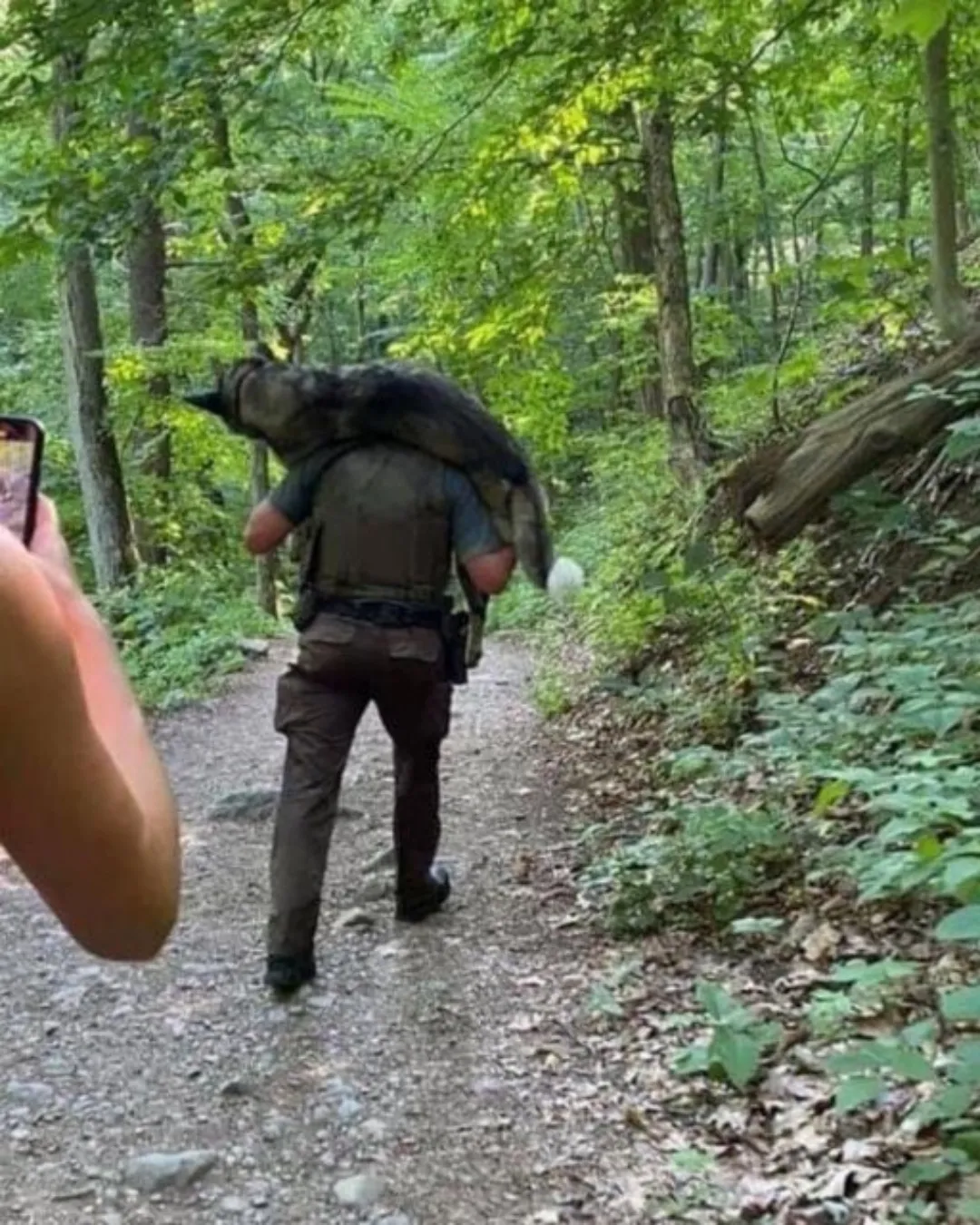
This summer, the heat was merciless. The kind of sun that makes the air feel thick, every step heavier than the last, and every heartbeat a reminder of how fragile life can be. On a rugged mountain trail, Lexi Daniel and her hiking group felt it in their bones—but no one was prepared for the moment that would test not just strength, but heart.
Ahead, crouched in exhaustion, was a man beside a German Shepherd. The dog lay on the rocky ground, tongue lolling, breathing shallow, its body trembling from the unforgiving heat. Lexi and her group offered water from their bottles, but it wasn’t enough. Every second counted. Every passing moment carried the weight of life and death.
Then came Ranger K. Salapek.
Without a word, without hesitation, he lifted the large, struggling dog onto his shoulders. The animal was heavy, limp with heatstroke, yet alive—fragile, holding on with every ounce of strength left. And so, Ranger Salapek began the descent: mile after mile, down steep trails, over jagged rocks, each step deliberate, careful, and full of determination.
At a stream halfway down, he paused. Gently, he lowered the dog into the cool water, letting it soak in relief, letting life return with every ripple. Once the dog’s breathing steadied, he lifted him again, muscles straining, sweat pouring, heart focused. Each step became a promise:
you will not be left behind. You will live.Lexi watched, amazed. She later wrote, “He is a HERO. The dog probably wouldn’t have survived without him.” And she was right.
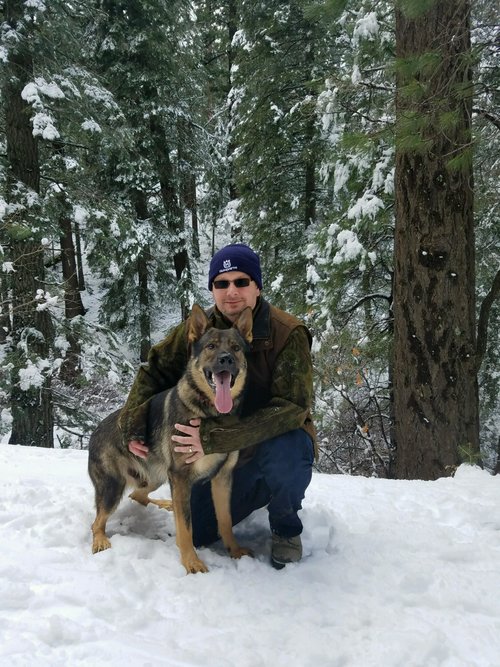
Hours later, after what felt like a journey through both heat and hope, the dog was safe. He would recover. And in the weeks that followed, the German Shepherd returned to his joyful self—running, tail wagging, back on his feet. The memory of that desperate hike faded, but the imprint of bravery and compassion remained.
Ranger Salapek didn’t seek recognition. He didn’t wait for applause. All he brought was his skill, his calm, and his willingness to shoulder the impossible. In doing so, he carried more than a dog—he carried hope, life, and a reminder that heroism can be quiet, steady, and tangible in ways that words often fail to capture.
Not all heroes wear capes. Some wear a ranger’s uniform. Some bear the weight of another being on their back. Some remind us that courage isn’t about glory—it’s about being present when someone needs you most. That summer day, Ranger Salapek didn’t just save a dog; he embodied the truest form of devotion and empathy, showing that even in the harshest conditions, humanity can shine.
When the dog’s tail wagged again, full of life and vigor, it was more than a recovery—it was a testament to a bond forged in crisis, and a hero who carried not just a body, but a heart on his back.
That German Shepherd survived because one man acted without hesitation, without doubt, and without concern for himself. And sometimes, that’s exactly what heroism looks like: quiet, heavy, steadfast, and alive in every step.